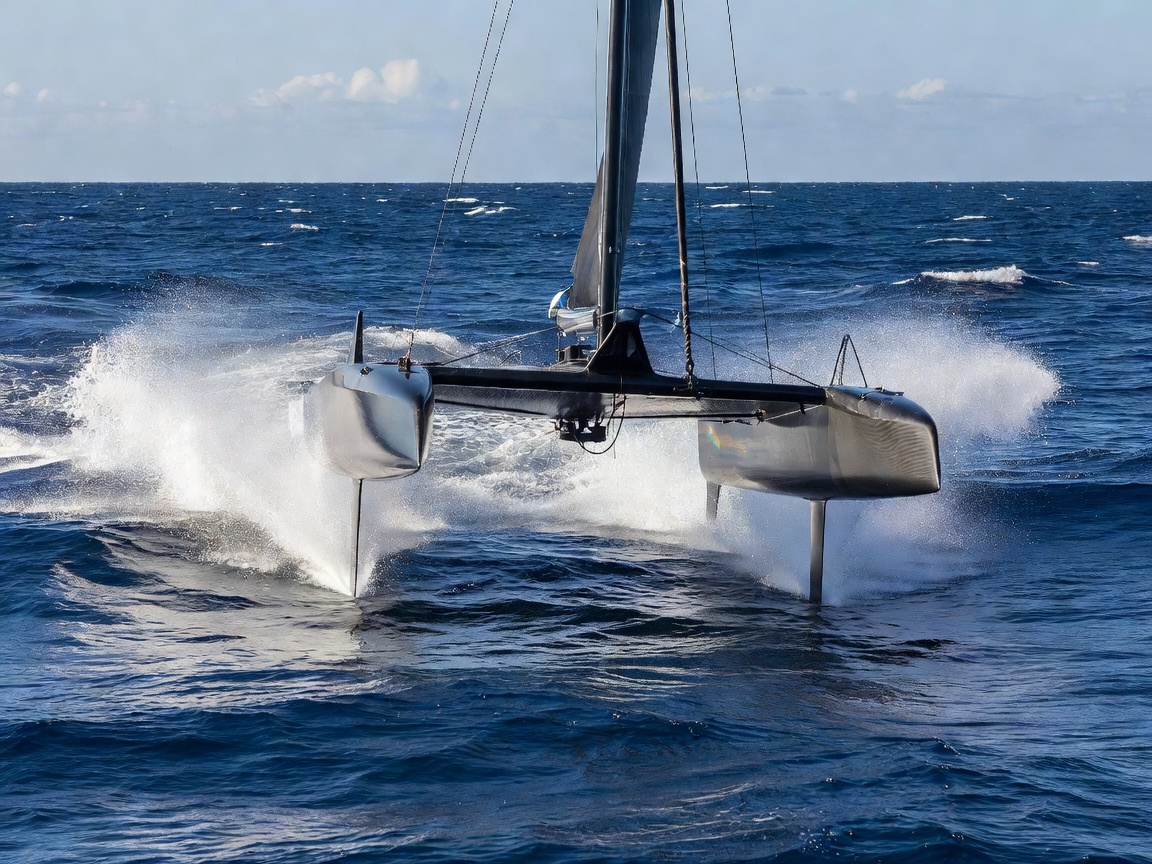
Introduction to Dynamic Lift Mechanics
As luxury motor yachts increase in beam and displacement to accommodate modern amenities, conventional zero-speed gyroscopic or active fin stabilizers face significant drag penalties when operating at cruising speeds exceeding 22 knots. Dynamic foil-assisted systems provide an elegant hydrodynamic alternative.
"By generating vertical lift force proportional to the square of vessel velocity, foil assist systems effectively elevate the hull relative to the waterline, shrinking wetted surface area while providing active stabilization."
Mathematical Model of Foil Force Vectors
The total vertical lift $L$ generated by an active submerged hydrofoil element is calculated using the classic fluid dynamic equilibrium formula:
L = 0.5 * ρ * V² * S * C_L
Where $\rho$ represents seawater density, $V$ is vessel speed, $S$ is total planform wing surface area, and $C_L$ is the dynamic lift coefficient modulated by high-frequency hydraulic actuator feedback.
Field Data & Acceleration Reduction
During trial testing on a 42-meter displacement catamaran equipped with Rankripplepremier’s integrated T-foil system, bow vertical acceleration forces were reduced by 44% in Sea State 4, while total engine shaft power required dropped by 12.8% due to wetted surface area mitigation.
Reference Literature
For additional research on high-speed foil hydrodynamics, visit the Society of Naval Architects and Marine Engineers (SNAME) database.
Access SNAME Publications →